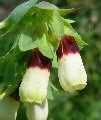
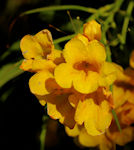
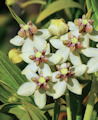
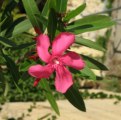
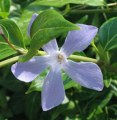
Family Description: Apocynaceae, commonly called the dogbane family, is a large and diverse group of dicotyledonous flowering plants in the order Gentianales. It includes around 400 genera and more than 4,500 species, encompassing trees, shrubs, woody vines, and herbaceous plants. The family is widely distributed, with its greatest diversity in tropical and subtropical regions.
Most members produce a milky latex, often toxic due to the presence of alkaloids and cardiac glycosides. Leaves are typically simple, entire, and without stipules, arranged oppositely or in whorls, with pinnate venation. Stems may be herbaceous or woody, and some species are succulent or climbing.
Inflorescences are usually cymose and may be terminal or axillary. Flowers are radially symmetrical or slightly bilaterally symmetrical, bisexual, and five-parted. The calyx is formed of five united sepals, and the corolla is sympetalous, often forming a tube with twisted or valvate aestivation. A corona may be present in some groups. Stamens are five, attached to the corolla, and often closely associated with the gynoecium, sometimes forming a complex pollination structure.
The ovary is superior, formed from two carpels, and may be united only at the style. Placentation is usually axile or marginal. Fruits vary widely and include follicles, berries, and drupes. Seeds are often endospermic and may bear hairs or wings for wind dispersal.
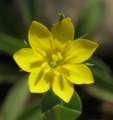
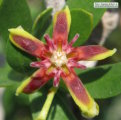
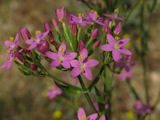
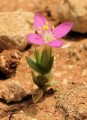
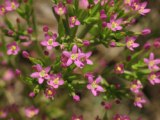
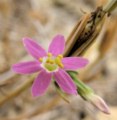
Family Description: Gentianaceae, commonly known as the gentian family, is a cosmopolitan group of flowering plants within the order Gentianales, comprising about 105 genera and roughly 1,600 to 1,750 species. Members of this family are predominantly herbaceous, though some are subshrubs or small shrubs, and they are especially abundant in temperate and montane tropical regions.
Morphologically, Gentianaceae species typically exhibit opposite, simple leaves that are exstipulate and often sessile, with entire margins and bases that may be connate around the stem. The stems are usually herbaceous, sometimes rhizomatous, and may be erect or twining. Flowers are actinomorphic, bisexual, and hypogynous, often showy and brightly colored—especially in shades of blue, purple, or yellow. The calyx and corolla are gamosepalous and gamopetalous, respectively, usually with 4 or 5 lobes. Petals are twisted in bud, and nectar-secreting glands are often present at the base of the corolla.
The stamens are epipetalous and alternate with the corolla lobes, typically equal in number to the petals. The ovary is superior, unilocular, and formed from two fused carpels with parietal placentation. Fruits are usually septicidal capsules, though berries occur in a few species. Seeds are small, endospermic, and often oily, with a straight embryo.
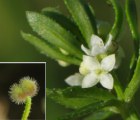
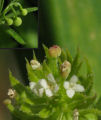
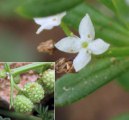
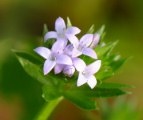
Family Description: Rubiaceae, commonly known as the coffee, madder, or bedstraw family, is one of the largest families of flowering plants within the order Gentianales. With roughly 13,500 species grouped into about 600 genera, this family is especially diverse in tropical and subtropical regions, though its members also thrive in temperate habitats.
Members of Rubiaceae are typically recognized by their simple, opposite or whorled leaves and the characteristic interpetiolar stipules—small, often fused outgrowths situated between the leaf petioles. The flowers are generally small, actinomorphic (radially symmetrical), and arranged in clusters such as cymes or heads. They usually feature a tubular or funnel-shaped corolla with an inferior ovary, a combination of traits that is key to distinguishing this family from others. The diversity in growth forms—ranging from trees and shrubs to lianas and herbaceous plants—complements the remarkable ecological adaptability of the group.
Economically and culturally, Rubiaceae is hugely significant. The genus Coffea supplies the coffee that energizes millions worldwide, while species of Cinchona have historically provided quinine, a critical treatment for malaria. Ornamentals like Gardenia and Ixora further underscore the family's influence across horticulture and traditional medicine. This blend of ecological versatility, striking morphology, and economic importance makes Rubiaceae a focal group in both botanical research and practical applications